THE CINCINNATI WEEKLY ENQUIRER
March 24, 1880
scans from newspaper collection
of
Ruth
Adams-Battle
transcribed by Liz Stratton

go to image:
page 1
page 2
page 3
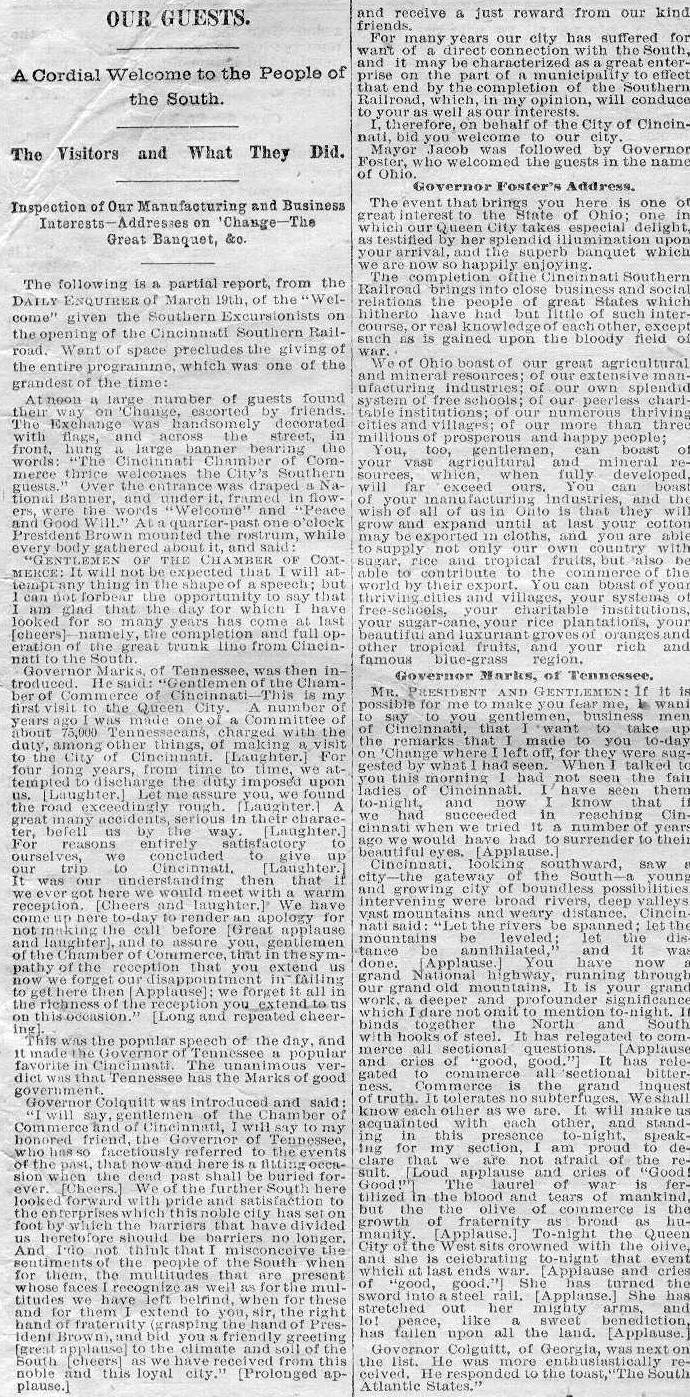
OUR GUESTS.
A Cordial Welcome to the
People of
The South.
The Visitors and What
They Did.
Inspection of Our Manufacturing
and Business
Interests – Addresses
on "Change—The
Great Banquet, &c.
The following is a partial report, from the DAILY ENQUIRER of March 19th,
of the "Welcome" given the Southern Excursionists on the opening of the
Cincinnati Southern Railroad. Want of space precludes the giving of the
entire programme, which was one of the grandest of the time:
At noon a large number of guests found their way on "change, escorted
by
friends. The Exchange was handsomely decorated with flags, and across
the
street, in front, hung a large banner bearing the words: "The
Cincinnati
Chamber of Commerce thrice welcomes the City's Southern guests." Over
the
entrance was draped a National Banner, and under it, framed in flowers,
were the words "Welcome" and "Peace and Good Will." At a quarter-past
one
o'clock President Brown mounted the rostrum, while every body gathered
about it, and said:
"Gentlemen of the Chamber of Commerce: It will not be expected that I
will
attempt any thing in the shape of a speech; but I can not forbear the
opportunity
to say that I am glad that the day for which I have looked for so many
years has come at last [cheers] – namely, the completion and full
operation
of the great trunk line from Cincinnati to the South.
Governor Marks of Tennessee, was then introduced. He said: "Gentlemen
of
the Chamber of Commerce of Cincinnati – This is my first visit to the
Queen
City. A number of years ago I was made one of a Committee of about
75,000
Tennesseeans, charged with the duty, among other things, of making a
visit
to the City of Cincinnati. [Laughter.] For four long years, from time
to
time, we attempted to discharge the duty imposed upon us. [Laughter.]
Let
me assure you, we found the road exceedingly rough. [Laughter.] A great
many accidents, serious in their character, befell us by the way.
[Laughter.]
For reasons entirely satisfactory to ourselves, we concluded to give up
our trip to Cincinnati. [Laughter.] It was our understanding then that
if we ever got here we would meet with a warm reception. [Cheers and
laughter.]
We have come up here to-day to render an apology for not making the
call
before [Great applause and laughter], and to assure you, gentlemen of
the
Chamber of Commerce, that in the sympathy of the reception that you
extend
us on his occasion." [Long and repeated cheering.]
This was the popular speech of the day, and it made the Governor of
Tennessee
a popular favorite in Cincinnati. The unanimous verdict was that
Tennessee
has the Marks of good government.
Governor Col1uitt was introduced and said:
"I will say, gentlemen of the Chamber of Commerce and of Cincinnati, I
will say to my honored friend, the Governor of Tennessee, who has so
facetiously
referred to the events of the past, that now and here is a fitting
occasion
when the dead past shall be buried forever. [Cheers.] We of the further
South here looked forward with pride and satisfaction to the
enterprises
which this noble city has set on foot by which the barriers that have
divided
us heretofore should be barriers no longer. And I do not think that I
misconceive
the sentiments of the people of the South when for them, the multitudes
that are present whose faces I recognize as well as for the multitudes
we have left behind, when for these and for them I extend to you, sir,
the right hand of fraternity (grasping the hand of President Brown),
and
bid you a friendly greeting [great applause] to the climate and soil of
the South [cheers] as we have received from this noble and this loyal
city."
[Prolonged applause.]
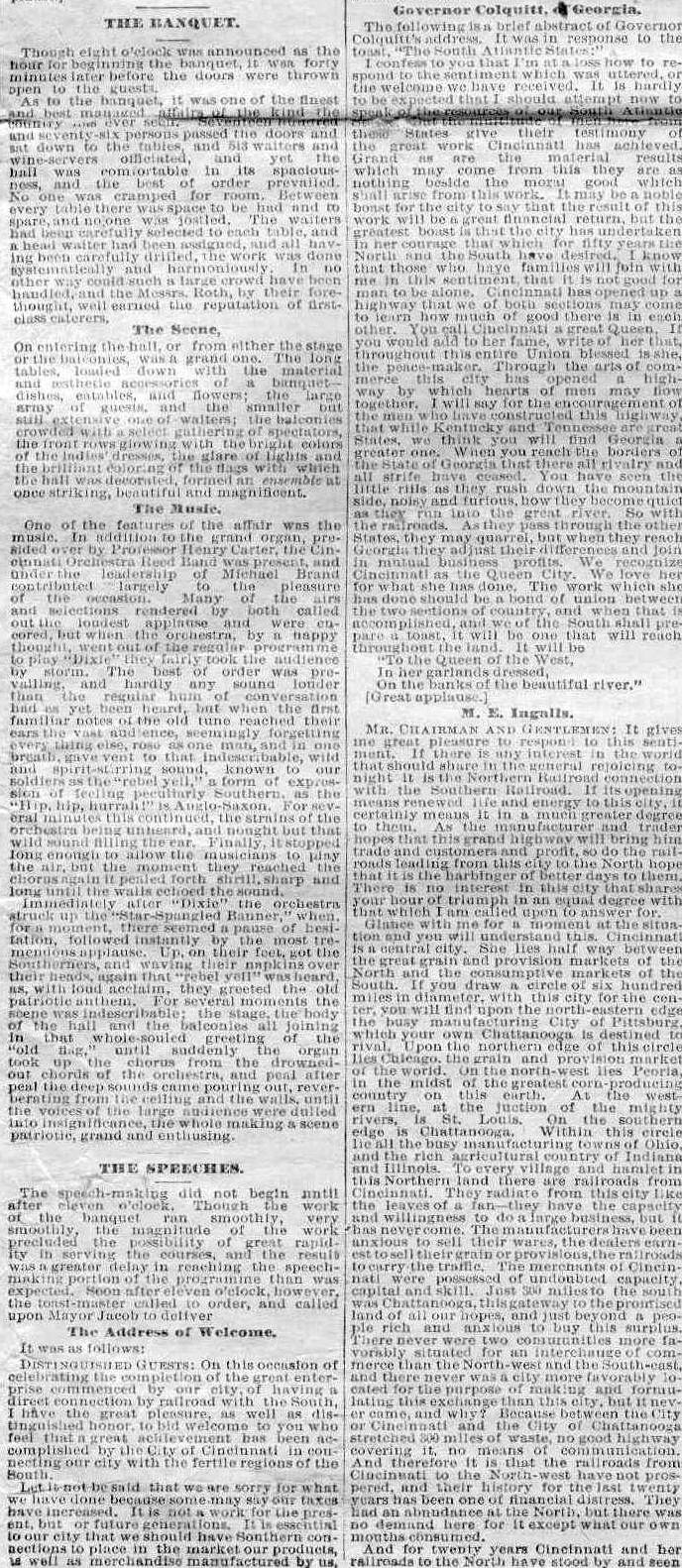
THE BANQUET.
Though eight o'clock was announced as the hour for beginning the
banquet,
it was forty minutes later before the doors were thrown open to the
guests.
As to banquet, it was one of the finest and best managed affairs of the
kind the country has ever seen. Seventeen hundred and seventy-six
persons
passed the doors and sat down to the tables, and 513 waiters and
wine-servers
officiated, and yet the hall was comfortable in its spaciousness, and
the
best of order prevailed. No one was cramped for room. Between every
table
there was space to be had and to spare, and no one was jostled. The
waiters
had been carefully selected to each table, and a head waiter had been
assigned,
and all having been carefully drilled, the work was done systematically
and harmoniously. In no other way could such a large crowd have been
handled,
and the Messrs. Roth, by their forethought, well earned the reputation
of first-class caterers.
The Scene.
On entering the hall, or from either the stage or the balconies, was a
grand one. The long tables, loaded down with the material and aesthetic
accessories of a banquet – dishes, eatables, and flowers; the large
army
of guests, and the smaller but still extensive one of waiters; the
balconies
crowded with a select gathering of spectators, the front rows glowing
with
the bright colors of the ladies' dresses, the glare of lights and the
brilliant
coloring of the flags with which the hall was decorated, formed an ensemble
at once striking, beautiful and magnificent.
The Music.
One of the features of the affair was the music. In addition to the
grad
organ, presided over by Professor Henry Carter, the Cincinnati
Orchestra
Reed Band was present, and under the leadership of Michael Brand
contributed
largely to the pleasure of the occasion. Many of the airs and
selections
rendered by both called out the loudest applause and were encored, but
when the orchestra, by a happy thought, went out of the regular
programme
to play "Dixie" they fairly took the audience by storm. The best of
order
was prevailing, and hardly any sound louder than the regular hum of
conversation
had as yet been heard, but when the first familiar notes of the old
tune
reached their ears the vast audience, seemingly forgetting every thing
else, rose as one man, and in one breath gave vent to that
indescribable,
wild and spirit-stirring sound, known to our soldiers as the "rebel
yell,"
a form of expression of feeling peculiarly Southern, as the "Hip, hip
hurrah!"
is Anglo-Saxon. For several minutes this continued, the strains of the
orchestra being unheard, and nought but that wild sound filling the
ear.
Finally, it stopped long enough to allow the musicians to play the air,
but the moment they reached the chorus again it pealed forth shrill,
sharp
and long until the wails echoed the sound.
Immediately after "Dixie" the orchestra struck up the "Star-Spangled
Banner,"
when for a moment, there seemed a pause of hesitation, followed
instantly
by the most tremendous applause. Up, on their feet, got the
Southerners,
and waving their napkins over their heads, again that "rebel yell" was
heard, as, with loud acclaim, they greeted the old patriotic anthem.
For
several moments the scene was indescribable; the stage, the body of the
hall and the balconies all joining in that whole-souled greeting of the
"old flag," until suddenly the organ took up the chorus from the
drowned
out chords of the orchestra, and peal after peal the deep sounds came
pouring
out, reverberating from the ceiling and the walls, until the voices of
the large audience were dulled into insignificance, the whole making a
scene patriotic, grand and enthusing.
THE SPEECHES.
The speech-making did not begin until after eleven o'clock. Though the
work of the banquet ran smoothly, very smoothly, the magnitude of the
work
precluded the possibility of great rapidity in serving the courses, and
the result was a greater delay in reaching the speech-making portion of
the programme than was expected. Soon after eleven o'clock, however,
the
toast-master called to order, and called upon Mayor Jacob to deliver.
The Address of
Welcome.
It was as follows:
DISTINGUISHED GUESTS: On this occasion of celebrating the completion of
the great enterprise commenced by our city, of having a direct
connection
by railroad with the South, I have a great pleasure, as well as
distinguished
honor, to bid welcome to you who feel that a great achievement has been
accomplished by the city of Cincinnati in connecting our city with the
fertile regions of the South.
Let it not be said that we are sorry for what we have done because some
may say our taxes have increased. It is not a work for the present, but
for future generations. It is essential to our city that we should have
Southern connections to place in the market our products, as well as
merchandise
manufactured by us, and receive a just reward from our kind friends.
For many years our city has suffered for want of a direct connection
with
the South, and it may be characterized as a great enterprise on the
part
of a municipality to effect that end by the completion of the Southern
Railroad, which, in my opinion, will conduce to your as well as our
interests.
I, therefore, on behalf of the City of Cincinnati, bid you welcome to
our
city.
Mayor Jacob was followed by Governor Foster, who welcomed the guests in
the name of Ohio.
Governor Foster's
Address.
The event that brings you here is one of great interest to the State of
Ohio; one in which our Queen City take especial delight, as testified
by
her splendid illumination upon your arrival, and the superb banquet
which
we are now so happily enjoying.
The completion of the Cincinnati Southern Railroad brings into close
business
and social relations the people of great States which hitherto have had
but little of such intercourse, or real knowledge of each other, except
such as is gained upon the bloody field of war.
We of Ohio boast of our great agricultural and mineral resources; of
our
extensive manufacturing industries; or our own splendid system of free
schools; or our peerless charitable institutions; of our numerous
thriving
cities and villages; of our more than three millions of prosperous and
happy people;
You, too, gentlemen, can boast of your vast agricultural and mineral
resources,
which, when fully developed, will far exceed ours. You can boast of
your
manufacturing industries, and the wish of all of us in Ohio is that
they
will grow and expand until at last your cotton may be exported in
cloths,
and you are able to supply not only our own country with sugar, rice
and
tropical fruits, but also be able to contribute to the commerce of the
world by their export. You can boast of your thriving cities and
villages,
your systems of free-schools, your charitable institutions, your
sugar-cane,
your rice plantations, your beautiful and luxuriant groves of oranges
and
other tropical fruits, and your rich and famous blue-grass region.
Governor Marks
of Tennessee
Mr. President and Gentlemen: If it is possible for me to make you fear
me, I want to say to you gentlemen, business men of Cincinnati that I
'want
to take up the remarks that I made to you to-day on 'Change where I
left
of, for they were suggested by what I had seen. When I talked to you
this
morning I had not seen the fair ladies of Cincinnati. I have seen them
to-night, and now I know that if we had succeeded in reaching
Cincinnati
when we tried it a number of years ago we would have had to surrender
to
their beautiful eyes. [Applause.]
Cincinnati, looking southward, saw a city – the gateway of the South –
a young and growing city of boundless possibilities, intervening were
broad
rivers, deep valleys, vast mountains and weary distance. Cincinnati
said:
"Let the rivers be spanned; let the mountains be leveled; let the
distance
be annihilated," and it was done. [Applause.] You have now a grand
National
highway, running through our grand old mountains. It is your grand
work,
a deeper and profounder significance which I dare not omit to mention
to-night.
It binds together the North and South with hooks of steel. It has
relegated
to commerce all sectional questions. [Applause and cries of "good,
good."]
It has relegated to commerce all sectional bitterness. Commerce is the
grand inquest of truth. It tolerates no subterfuges. We shall know each
other as we are. It will make us acquainted with each other, and
standing
in this presence to-night, speaking for my section, I am proud to
declare
that we are not afraid of the result. [Loud applause and cries of
"Good!
Good!"] The laurel of war is fertilized in the blood and tears of
mankind,
but the olive of commerce is the growth of fraternity as broad as
humanity.
[Applause.] To-night the Queen City of the West sits crowned with the
olive,
and she is celebrating to-night that event which at last ends war.
[Applause
and cries of "good, good."] she has turned the sword into a steel rail.
[Applause.] She has stretched out her mighty arms, and lo! Peace, like
a sweet benediction has fallen upon all the land. [Applause.]
Governor Colguitt, of Georgia, was next on the list. He was more
enthusiastically
received. He responded to the toast, "The South Atlantic States."
Governor Colquitt,
of Georgia.
The following is a brief abstract of Governor Colquitt's address. It
was
in response to the toast, "The South Atlantic States."
I confess to you that I'm at a loss how to respond to the sentiment
which
was uttered, or the welcome we have received. It is hardly to be
expected
that I should attempt now to speak of the resources of our South
Atlantic
State, that the multitude of men have from these States give their
testimony
of the great work Cincinnati has achieved. Grand as are the material
results
which may come from this they are as nothing beside the moral good
which
shall arise from this work. It may be a noble boast for the city to say
that the result of this work will be a great financial return, but the
greatest boast is that the city has undertaken in her courage that
which
for fifty years the North and the South have desired. I know that those
who have families will join with me in this sentiment, that it is not
good
for man to be alone. Cincinnati has opened up a highway that we of both
sections may come to learn how much of good there is in each other. You
call Cincinnati a great Queen. If you would add to her fame, write of
her
that throughout this entire Union blessed is she, the peace-maker.
Through
the arts of commerce this city has opened a highway by which hearts of
men may flow together. I will say for the encouragement of the men who
have constructed this highway, that while Kentucky and Tennessee are
great
States, we think you will find Georgia a greater one. When you reach
the
borders of the State of Georgia that there all rivalry and all strife
have
ceased. You have seen the little rills as they rush down the mountain
side,
noisy and furious, how they become quiet as they run into the great
river.
So will the railroads. As they pass through the other States, they may
quarrel, but when they reach Georgia they adjust their differences and
join in mutual business profits. We recognize Cincinnati as the Queen
City.
We love her for what she has done. The work which she has done should
be
a bond of union between the two sections of country, and when that is
accomplished,
and we of the South shall prepare a toast, it will be one that will
reach
throughout the land. It will be
"To the Queen of the West,
In her garlands dressed,
On the banks of the beautiful river."
[Great applause.]
M. E. Ingalls.
MR. CHAIRMAN AND GENTLEMAN: It gives me great pleasure to respond to
this
settlement. If there is any interest in the world that should share in
the general rejoicing tonight it is the Northern Railroad. If its
opening
means renewed life and energy to this city, it certainly means it in a
much greater degree to them. As the manufacturer and trader hopes that
this grand highway will bring him trade and customers and profit, so do
the railroads leading from this city to the North hope that it is the
harbinger
of better days to them. There is no interest in this city that shares
your
hour of triumph in an equal degree with that which I am called upon to
answer for.
Glance with me for a moment at the situation and you will understand
this.
Cincinnati is a central city. She lies half way between the great grain
and provision markets of the North and the consumptive markets of the
South.
If you draw a circle of six hundred miles in diameter, with this city
for
the center, you will find upon the north-eastern edge the busy
manufacturing
City of Pittsburg, which your own Chattanooga is destined to rival.
Upon
the northern edge of this circle lies Chicago, the grain and provision
market of the world. On the north-west lies Peoria, in the midst of the
greatest corn-producing country on this earth. At the western line, at
the junction of the mighty rivers is St. Louis. On the southern edge is
Chattanooga. Within this circle lie all the busy manufacturing towns of
Ohio, and the rich agricultural country of Indiana and Illinois. To
every
village and hamlet in this Northern land there are railroads from
Cincinnati.
They radiate from this city like the leaves of a fan – they have the
capacity
and willingness to do a large business, but it has never come. The
manufacturers
have been anxious to sell their wares, the dealers earnest to sell
their
grain or provision, the railroads to carry the traffic. The merchants
of
Cincinnati were possessed of undoubted capacity, capacity and skill.
Just
500 miles to the south was Chattanooga, this gateway to the promised
land
of all our hopes, and just beyond a people rich and anxious to buy this
surplus. There never were two communities more favorably situated for
an
interchange of commerce than the North-west and the South-east, and
there
never was a city more favorably located for the purpose of making and
formulating
this exchange than this city, but it never came, and why? Because
between
the City of Cincinnati and the City of Chattanooga stretched 500 miles
of waste, no good highway covering it, no means of communication. And
therefore
it is that the railroads from Cincinnati to the North-west have not
prospered,
and their history for the last twenty years has been one of financial
distress.
They had an abundance at the North, but there was no demand here for it
except what our own mouths consumed.
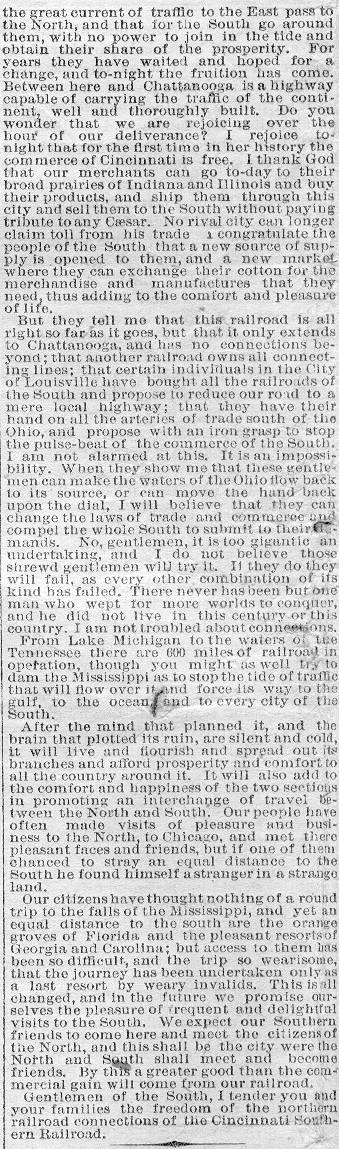
And for twenty years Cincinnati and her railroads to the North have
stood
by and seen the great current of traffic to the East pass to the North,
and that for the South go around them, with no power to join in the
tide
and obtain their share of the prosperity. For years they have waited
and
hoped for a change, and to-night the fruition has come. Between here
and
Chattanooga is a highway capable of carrying the traffic of the
continent,
well and thoroughly built. Do you wonder that we are rejoicing over the
hour of deliverance? I rejoice to-night that for the first time in her
history the commerce of Cincinnati is free. I thank God that our
merchants
can go to-day to their broad prairies of Indiana and Illinois and buy
their
products, and ship them through this city and sell them to the South
without
paying tribute to any Caesar. No rival city can longer claim toll from
his trade. I congratulate the people of the South that a new source of
supply is opened to them, and a new market where they can exchange
their
cotton for the merchandise and manufactures that they need, thus adding
to the comfort and pleasure of life.
But they tell me that this railroad is all right so far as it goes, but
that it only extends to Chattanooga, and has no connections beyond;
that
another railroad owns all connecting lines; that certain individuals in
the City of Louisville have bought all the railroads of the South and
propose
to reduce our road to a mere local highway; that they have their hand
on
all the arteries of trade south of the Ohio, and propose with an iron
grasp
to stop the pulse-beat of the commerce of the South. I am not alarmed
by
this. It is an impossibility. When they show me that these gentlemen
can
make the waters of the Ohio flow back to its source, or can move the
hand
back upon the dial, I will believe that they can change the laws of
trade
and commerce and compel the whole South to submit to their demands. No,
gentlemen, it is too gigantic an undertaking, and I do not believe
those
shrewd gentlemen will try it. If they do they will fail, as every other
combination of its kind has failed. There never has been but one man
who
wept for more worlds to conquer, and he did not live in this century or
this country. I am not troubled about connections.
From Lake Michigan to the waters of the Tennessee there are 600 miles
of
railroad in operation, though you might as well try to dam the
Mississippi
as to stop the tide of traffic that will flow over it and force its way
to the gulf, to the ocean, and to every city of the South.
After the mind that planned it, and the brain that plotted its ruin,
are
silent and cold, it will live and flourish and spread out its branches
and afford prosperity and comfort to all the country around it. It will
also add to the comfort and happiness of the two sections in promoting
an interchange of travel between the North and South. Our people have
often
made visits of pleasure and business to the North, to Chicago, and met
there pleasant faces and friends, but if one of them chanced to stray
an
equal distance to the South he found himself a stranger in a strange
land.
Our citizens have thought nothing of a round trip to the falls of the
Mississippi,
and yet an equal distance to the south are the orange groves of Florida
and the pleasant resorts of Georgia and Carolina; but access to them
has
been so difficult, and the trip so wearisome, that the journey has been
undertaken only as a last resort by invalids. This is all changed, and
in the future we promise ourselves the pleasure of frequent and
delightful
visits to the South. We expect our Southern friends to come here and
meet
the citizens of the North, and this shall be the city were the North
and
South shall meet and become friends. By this a greater good than the
commercial
gain will come from our railroad.
Gentlemen of the South, I tender you and your families the freedom of
the
northern railroad connections of the Cincinnati Southern Railroad.
Back to:
March 24, 1880
Index
©2003, 2004 by Linda
Boorom & Tina Hursh