
THE CINCINNATI TIMES-STAR
November 1, 1904
NEWS
scans from newspaper collection
of
Ruth
Adams-Battle
Transcribed by Liz Stratton

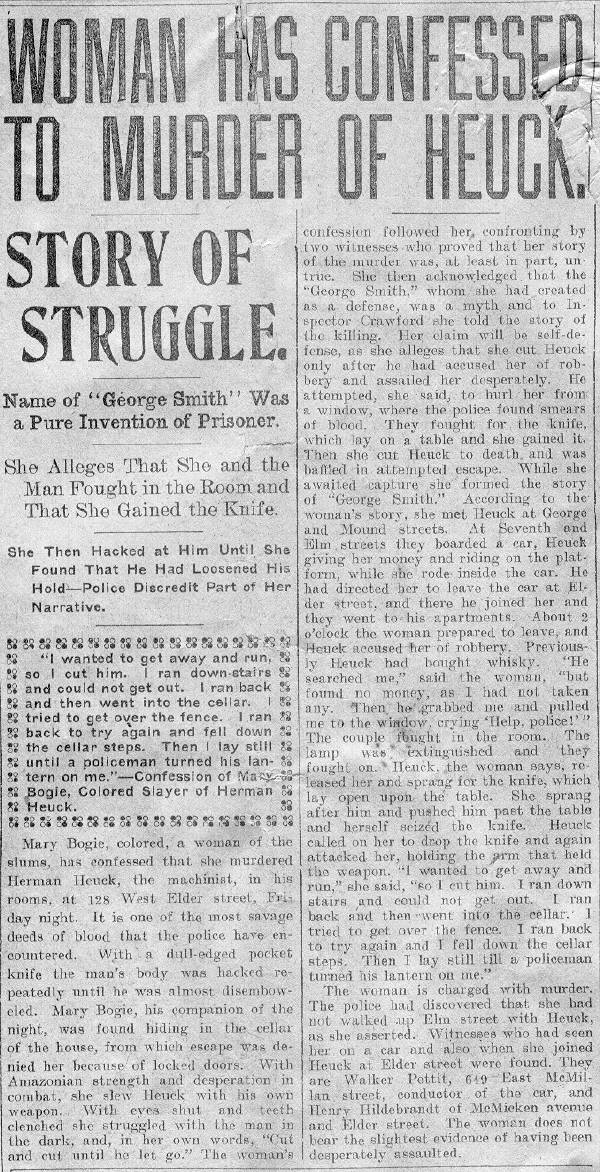
WOMAN HAS CONFESSED TO MURDER OF HEUCK.
Story of Struggle.
Name of "George Smith" Was a Pure Invention
of Prisoner.
She Alleges That She and the Man Fought
in the Room and That She Gained the Knife.
She Then hacked at Him Until She Found
That He Had Loosened His Hold -
Police Discredit Part of Her Narrative.
“I wanted to get away
and run, so I cut him. I ran down-stairs and could not get
out.
I ran back and then went into the cellar. I tried to get over the
fence. I ran back to try again and fell down the cellar
steps.
Then I lay still until a policeman turned his lantern on me.”
–Confession
of Mary Bogle, Colored Slayer of Herman Heuck.
Mary Bogie, colored a woman
of the slums, has confessed that she murdered Herman Heuck, the
machinist,
in his rooms at 128 West Elder street, Friday night. It is one of
the most savage deeds of blood that the police have encountered.
With a dull-edged pocket knife the man’s body was hacked repeatedly
until
he was almost disemboweled. Mary Bogie, his companion of the
night,
was found hiding in the cellar of the house, from which escape was
denied
her because of locked doors. With Amazonian strength and
desperation
in combat, she slew Heuck with his own weapon. With eyes shut and
teeth clenched she struggled with the man in the dark, and, in her own
words, “Cut and cut until he let go.” The woman’s confession
followed
her confronting by two witnesses who proved that her story of the
murder
was, at least in part, untrue. She then acknowledged that the
“George
Smith,” whom she had created as a defense, was a myth and to Inspector
Crawford she told the story of the killing. Her claim will be
self-defense,
as she alleges that she cut Heuck only after he had accused her of
robbery
and assailed her desperately. He attempted, she said, to hurl her
from the window, where the police found smears of blood. They
fought
for the knife, which lay on a table and she gained it. Then she
cut
Heuck to death, and was baffled in attempted escape. While she
awaited
capture she formed the story of “George Smith.” According to the
woman’s story, she met Heuck at George and Mound streets. At
Seventh
and Elm streets they boarded a car, Heuck giving her money and riding
on
the platform, while she rode inside the car. He had directed her
to leave the car at Elder street, and there he joined her and they went
to his apartments. About 2 o’clock the woman prepared to leave
and
Heuck accused her of robbery. Previously Heuck had bought
whisky.
“He searched me,” said the woman, “but found no money, as I had not
taken
any. Then he grabbed me and pulled me to the window crying ‘Help,
police!’” The couple fought in the room. The lamp was
extinguished
and they fought on. Heuck, the woman says released her and sprang
for the knife, which lay open upon the table. She sprang after
him
and pushed him past the table and herself seized the knife. Heuck
called on her to drop the knife and again attacked her, holding the arm
that held the weapon. “I wanted to get away and run,” she said,
“so
I cut him. I ran downstairs, and could not get out. I ran
back
and then went into the cellar. I tried to get over the
fence.
I ran back to try again and I fell down the cellar steps. Then I
lay still till a policeman turned his lantern on me.”
The woman is charged
with murder. The police had discovered that she had not walked up
Elm street with Heuck, as she asserted. Witnesses who had seen
her
on a car and also when she joined Heuck at Elder street were
found.
They are Walker Pottit, 619 East McMillan street, conductor of the car,
and Henry Hildebrandt of McMicken avenue and Elder street. The
woman
does not bear the slightest evidence of having been desperately
assaulted.
Back to:
November 1,
1904 Index
©2003, 2004 by Linda
Boorom & Tina Hursh